Monday, October 22, 2007

Mahamrtyunjaya


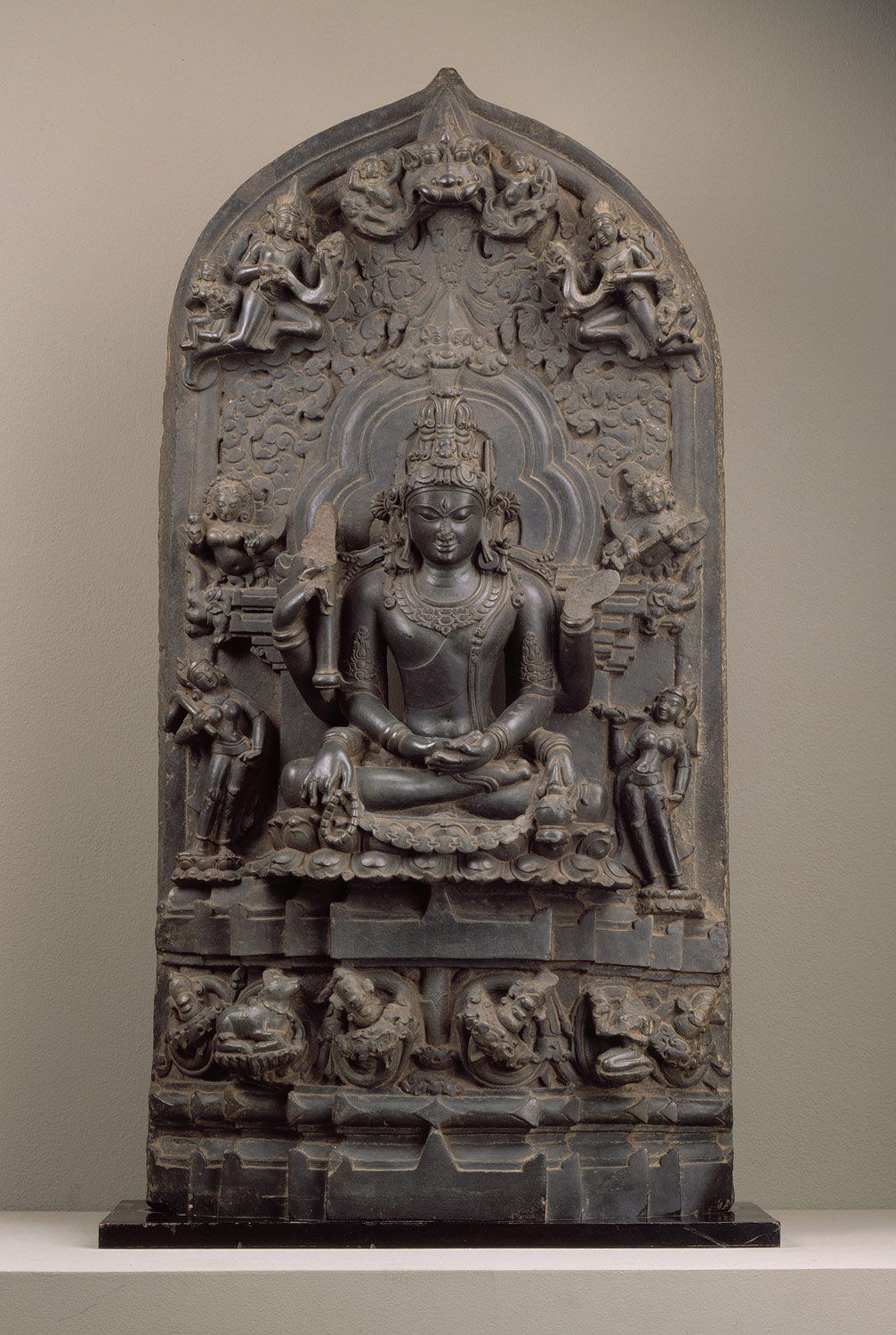
Siva Mrtyunjaya

Seated six-armed Shiva as Conquerer of Death (Mrtyunjaya), Pala period (ca. 700–1200), 12th century
Bangladesh or India (west Bengal)
Black stone; H. 39 in. (99.1 cm), W. 18 1/2 in. (47 cm)


Monday, October 15, 2007

beautiful picture of Venusji


A beautiful Yoni suggestive portrait of a beautiful Goddess. by Titian. read more...

Yakshas


I'm starting, or should at the moment be starting to compose a prospectus for what will be my final formal assigned research paper (I hope!) -other than my thesis. I am fascinated with Yakshas and Yakshis. Well not really, but I am fascinated with Vraj and they fit into the picture, along with Naga puja.

Vry little work has been done in this area, the first by Coomaraswamy, followed by an excellent work by Misra and Sutherland (The Disguises of the Demon:... SUNY 1991). As there was apparently no liturature associated directly with their worship, pieces have to be assembled from Buddhist, Jain, and other texts, as well as the numerous images extant.

What I said in a previous entry is not true; there is no proof Vrnda was a Yaksi, but there is a lot of evidence that local Goddesses were incorporated into early Vaisnavism (and Saivism). I say I worship Shri Krishna, but it is not the same Krishna another may worship who may incorporate more or less aspects of the respective contemplators' ego misconceptions.

That is a different story though. The Tulasi/Vrnda thing will not be cessed out by me, or anyone. Does (did) Vrnda equal the plant Tulasi? By the time of Rupa Goswamin it did. Was Vrnda simply a Vandevi -protectress of the forest?

Bhandiravan was noted as being the center of worship for a certain Yaksha. The famous Parkham image was worshiped right up until the time the Brits put the devata (as he was discribed by the villagers) in the Mathura museum. Misra says the Yaksha cult was existing concurrently with Buddhism etc.

Krishna lila as per Bhagavatam is filled with stories of Shri Krishna subduing snakes, and other local deities. But he did not kill Kaliya, only won him over. Varuna who was called a Yaksha (and asura) in various references, was chastened by Krishna. Nalakuvera and Manigriva, sons of the Yaksharaj Kubera liberated from trees -which along with water were considered the abode of Yakshas. I need to check on Sankacuda, whether he was a Rakshasa or Yaksha...Yaksha I think. If so it is quite interesting for the Tulasi story. A different Shankacuda is named, a non-Vaisnava, vanquished by Vishnu (worshipper of Siva, as it were), whose body turned to conch (Yaksha symbol-hold water) in the ocean (the abode of Varuna) and Tulasi (a type of tree/plant - associated with Yaksha also as mentioned above), become the consort of the mountain-born Vishnu as Saligrama. In some stories the figure is named Jalandhara (water holder ) born from Siva's third eye and the ocean (or from Gangaji depending on what you prefer).
The Yaksas (I) statues we see likely predate some of these Puranik stories. Sankacuda is called a Danava in the BvP and Jalandhara an asura in PP , as is Varuna in Rg V. etc.It doesn't really matter either way though, because I may be familiar with more of the versions of the story than the persons back then who wrote and added to the Puranas. They were probably writing verses of oral versions that varied from region to region anyway. Its a fun thing to ponder though.
Saturday, October 13, 2007

title picture

I am honored to give my dear friend of many years Aishvarya Das credit for the wonderful photo on the blog homepage. I have many paper photos of Sri Vraj I would like to scan. This is a very fine photo, that perfectly captures the late rainy season of Vraj. The heady smell of overripe Kadamba flowers, the moist Earth, perfumed smoke from fires. The soul is on fire. The onset of Autumn. I will never escape now.

more N.P.

The notes by Sw. Vijnananada go on to say that these subtle forms of gods manifest on their festival days either seen or unseen to the participants.

He also says in the intro that the NP contains the essence of what Sri Vallabh taught, when in fact it is much more similar to Gaudiya thought in my opinion; that is the development of the Pancaratra away from the obligatory discussion of the vyuhas etc. Alot is found about Sri Radha, including her sahasranam as well as that of Gopal. Obviously a lot of Kundalini references. There is a lot of stuff that would be considered sakama bhakti by most ardent Vaisnavs; instructins for puja to gain certain boons etc. Radha and Krishna are the only deities honored.

Elucidation and construction of mantras is a concern. Very similar to some stuff I read in the Brahmavaivarta P. today, as a matter of fact. They are very similar texts in many ways. I agree with Cheever Mackenzie-brown and others that there is much Bengali influence at least in BvP. Puri is mentioned; the name Ayana is found (for someone, I can't remember), a popular name in medieval Bengal apparently.

Swamiji concludes his intro with a very strange passage of how the development Ekanta worship of Bhagavan was concurrent with Christian missions in S. India, and the Vaisnavs borrowed from them, but Hinduism is the mother of all (?) I didn't get his point. Or perhaps I did get it and it just was a non-sequitur of the likes sometimes uttered by the devoutly religious, I don't know.

Strangely the NP, as well as the Vraj Kartik-like weather coming over N. Florida is making me intrested in GV again. I took a book of Ananta Das Pandit Baba yesterday and read wit great interest. Nostalgia for somethings such as the katha of Babaji Maharaj confer benedictions that are untouched by time and space.

The marvel of Vaisnavism to me over all Indic philosophies and otherwise is the level of pure and dedicated selflessness one relishes. Not selflessness, or realization of the Self for the sake of Mukti, but the desire to give relish to the concentrated bliss which is Parabrahman, known variously by the muktas.

A selfless exchange of love, that transcends and religious concern or even self-concern.
What is better than that?!

Wednesday, October 10, 2007

Narada Pancaratra

Reading the Narada Pancaratra of Swami Vijnananda with interest. Actually I just photocopied most of it. I have many comments; it has been a most interesting read. My initial reaction to it was "this is just another ritualitic late semi-tantrik text(actually fully tantrik in many senses)". Then it drew me in. I would have been quite excited to have this as a more esoteric iskconer back in the day. It shows a time when yoga and bhakti were more inimately related, and the Agamas were the ritual guide. It is quite a bit more interesting than the 'churchy' 'Krishna saves' bhakti that IGM and others promote. This is bhakti meant to be experienced, by power of realization of the Self. The kanistha cannot concieve of a Krishna that exists outside of the realm of ego, thus God becomes the one to fear, or to please, as being trapped in the ego fueled mind, there is no experience of anything else. Therefore Krishna must be a historical person, God himself, as if any of this mattered. There are indeed many 'Krishnas' but that is the subject of a different entry.

Some meditations I began to recently perform spontaneously I found described here, which I found interesting too. The text seems to perfectly ride the middle ground between advaitik Siva-sakti siddhant (of course named Sri Radha-Krsna here), and Vaisnava nitya-seva.

Swamiji makes an interesting note at the end of the 3rd night:

"Where do Sri Krsna and the other devatas reside? The Devas perfectly exist in their causal bodies in mental and Budhhic planes. They become partially hidden when they come down and assume subtle bodies; but, then we see more powers manifested in them. The Devas are all real and true.

The Devas have forms which become visible to men in their heartsand in the ajna cakra, if they believe they will see...(omiting some due to time constraitnts)

Sri krsna lives in Vrndavan, in the heart. He lives also in Ajna cakra and in sahasrar. There is also the Vrindavan dham, higher in the celestial regions. Sri Mahadeva lives in Kailas where the three vital currents Ida, Pingala, and Susumna meet in Ajna and Sahasrar. Brahma lives in the navel of Manipur (solar) plexus..."

Tuesday, October 9, 2007

sailing mishap

My wife and I were windsurfing off of Shellpoint this past Sunday, when faulty equipment, unfavorable winds and a rapidly approaching squall left her stranded offshore and in a state of panic. I swam to meet her quite far, perhaps 150 yards or more, it was tough to tell. There were people catching sharks on the beach, and I kept feeling my limbs brushing things underwater, which is quite deep in the channel. I understood that if I panicked also, we would be in big trouble. Luckily some kind people took care of our son who was playing on the beach. Shortly after I reached her, as I was catching my breath, a boat came by and helped us out, just as the storm approached, sending driving rain like bullets. I jumped off the boat and dragged the gear to shore, the wind lifting the 11 foot board. By the time I got to where my son was, he was shivering but in good hands with a family and a middle aged couple from Indiana who had just moved to Florida. Members of the sailboard club who were on the beach doing some project did nothing to help, which is still making me angry. They did not even come up afterwards to see if she was OK. A very sad show of seamanship indeed. But I felt fortunate to be helped by so many kind people. It is not often one find oneself in a helpless state, at least I am quite fortunate. The ocean and water in general is a powerful force that must be respected. That, thankfully, my dear father taught me, though I thought he was just being overcautious when I was young on the boat. I went along with my wife's stubbornness to sail that day, though I knew the wind was blowing sideshore. I also didn't stop to think that she isn't as familiar with the Gulf as I. Even though I was scared I know what kind of sharks and other sealife are in these waters over the grass flats. Nothing terribly dangerous save bull sharks; rated as the most deadly on the discovery channel. The kid looked like he had a small hammerhead. The summer spawn have grown. I wonder when the mamas head back out to sea? It was a pretty intense experience, and we learned much... the hard way. But I passed a test of sorts. But you would have to be me to understand.

Monday, October 1, 2007

Mundaka 3.2.3

"This Self cannot be attained by instruction nor by intellectual
power nor even through much hearing. He is to be attained by
the one whom (the Self) chooses"

An oft quoted verse worthy of reflection